Over centuries, our world has been shaped by remarkable events and cultures, leaving behind iconic historic sites that tell their stories. In this guide, you will explore the top 10 historic sites that not only inspire awe but also offer profound insights into our shared heritage. As you journey through these breathtaking locations, you’ll discover the rich tapestry of human history that awaits you, encouraging both reflection and appreciation for what has come before. Get ready to expand your horizons and launch on a memorable adventure through time!
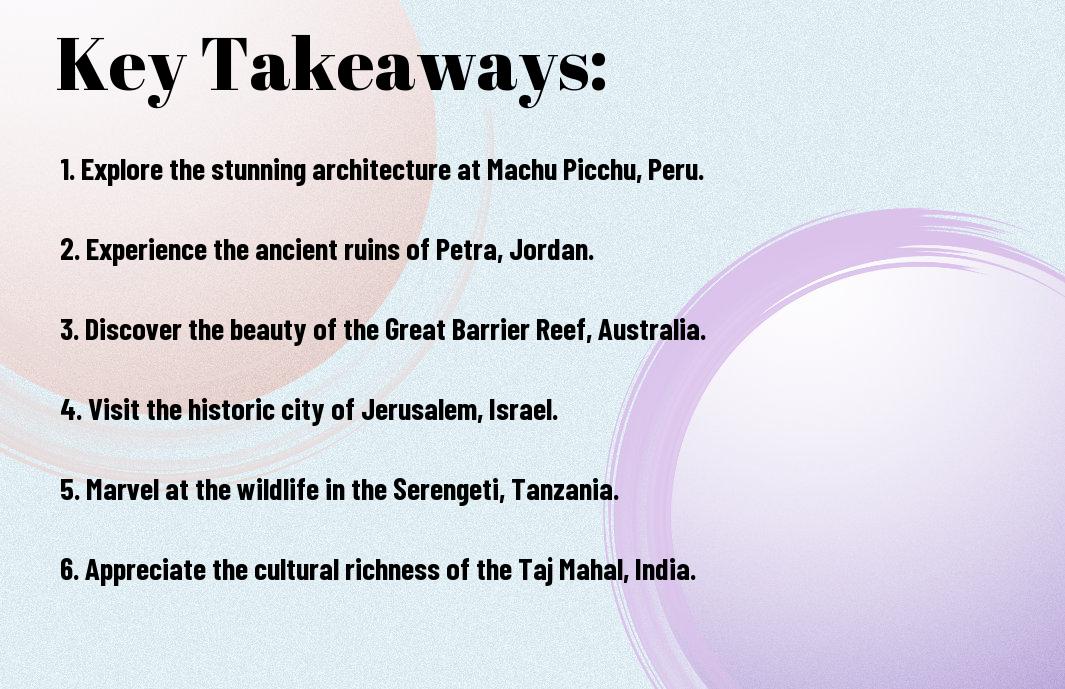
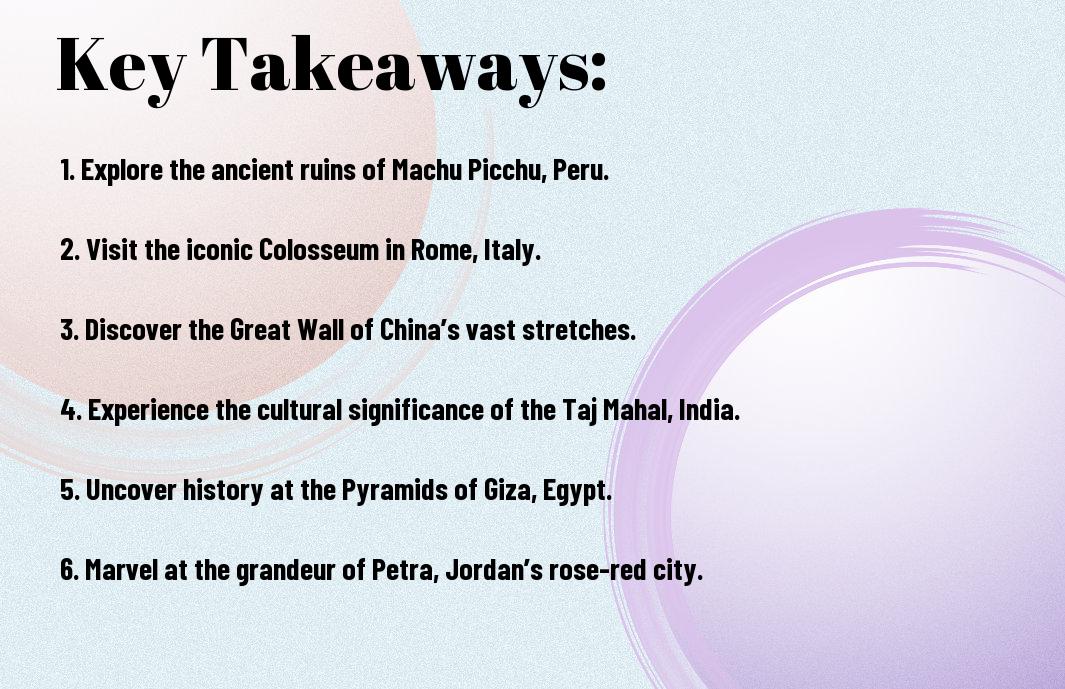
Key Takeaways:
- Diverse Heritage: The list includes sites from various cultures, showcasing the richness of human history.
- Architectural Marvels: Many sites are notable for their stunning architecture, attracting millions of visitors each year.
- UNESCO World Heritage Sites: Several of the top locations are recognized by UNESCO, indicating their global significance and conservation status.
- Cultural Experiences: Visiting these sites offers immersive experiences into the past, enhancing understanding of different civilizations.
- Global Accessibility: Many sites are located in accessible regions, making them popular destinations for travelers worldwide.

Great Wall of China
Your visit to the Great Wall of China unveils one of the most significant architectural wonders in human history. Spanning over 13,000 miles, this ancient fortification was originally built to protect Chinese states from invasions and now stands as a testament to the ingenuity and endurance of a civilization that has thrived for thousands of years. Walking along the wall not only offers a glimpse into the past but also immerses you in the stunning landscapes that surround this iconic structure.
Iconic ancient fortification
You’ll be amazed as you traverse sections of the Great Wall, each telling its own story of ambition and resilience. Constructed over several dynasties, this monumental feat of engineering showcases ancient Chinese military prowess. The well-preserved battlements, watchtowers, and scenic surroundings create a captivating experience that connects you with the rich history of the nation.
Panoramic mountain views
Views from the Great Wall offer breathtaking vistas that stretch across serene mountains and lush valleys. As you walk along the wall’s ridges, you’ll find yourself immersed in nature, with magnificent panoramas waiting around every bend, capturing the essence of China’s diverse landscapes.
China’s breathtaking panoramas from the Great Wall will leave you awestruck. Each step rewards you with sweeping views of rugged mountains and sprawling forests, enhancing your journey with naturally breathtaking scenery. Whether wrapped in the vibrant colors of autumn or blanketed in serene winter snow, these views transform with the seasons, making each experience unique. Pausing at strategic lookout points allows you to appreciate both the grandeur of the wall and the stunning vistas, providing countless photo opportunities that you’ll cherish long after your visit.
Machu Picchu, Peru
Some of the most iconic and captivating ruins globally reside in Machu Picchu, Peru. This Incan citadel, perched high in the Andes mountains, offers a glimpse into the rich history and incredible architectural prowess of the Inca civilization. A UNESCO World Heritage site, Machu Picchu draws visitors from all over the world, eager to explore its ancient temples, terraces, and plazas, all while taking in a breathtaking landscape that perfectly encapsulates the essence of Peru.
Incan Citadel Ruins
Machu Picchu showcases the remarkable ingenuity of the Inca civilization. Built in the 15th century, this extensive complex features intricately carved stone structures that have withstood the test of time. As you walk through the site, observe the agricultural terraces, religious temples, and residences that tell the story of a vibrant community that flourished in this remote location.
Stunning Mountainous Backdrop
On your visit to Machu Picchu, you’ll be captivated by the stunning mountainous backdrop that surrounds the site. The dramatic peaks and lush valleys create a striking contrast with the ancient ruins, enhancing the sense of adventure and exploration. This breathtaking scenery not only offers abundant photo opportunities but also provides a sense of tranquility as you connect with nature and the history of the Incas.
To fully appreciate the stunning mountainous backdrop, consider hiking the Inca Trail or the shorter alternative trails that lead to Machu Picchu. These paths will immerse you in the breathtaking landscapes of the Andes, revealing captivating views that change with each step. As you ascend, the combination of lush greenery and towering peaks amplifies the site’s mystical aura, allowing you to take in the majestic beauty of the area before arriving at the citadel itself. The experience of standing at Machu Picchu, with its awe-inspiring vista, is something you will cherish forever.
Pyramids of Giza
Keep the Pyramids of Giza at the top of your travel list, as they are an awe-inspiring testament to ancient Egyptian civilization. Built over 4,500 years ago, these monumental structures continue to captivate visitors with their grandeur and mathematical precision. The Great Pyramid of Khufu, the largest of the three, was originally 146.6 meters tall and remains a marvel of engineering and design, drawing travelers from around the globe to explore its rich history and significance.
Ancient Burial Structures
Structures like the Pyramids served as monumental tombs for Egyptian pharaohs, showcasing the culture’s reverence for the afterlife. Encased in elaborate chambers filled with treasures and offerings, these burial sites demonstrated both the pharaoh’s power and their beliefs in immortality. As you explore, you’ll notice the intricate hieroglyphs and designs that illuminate the burial rituals practiced thousands of years ago, providing a fascinating glimpse into ancient Egyptian society.
Mysteries of Pharaohs
Pyramids have long been shrouded in mysteries that intrigue historians and archaeologists alike. Despite extensive research, the exact methods of construction remain a topic of debate, as the logistics of moving massive stones without modern machinery challenge conventional understanding. Furthermore, the purpose of the hidden chambers continues to spark curiosity, leading to various theories about their significance in the pharaohs’ transition to the afterlife.
It is this enigma surrounding the pyramids that makes a visit to Giza even more compelling. You may find yourself pondering the lives of those entombed within, as each pyramid serves as a portal to a time when the pharaohs ruled with divine authority. The incredible precision of their architecture and the alignment with the stars amplify the intrigue, making you feel connected to ancient history. The mysteries may never be fully unraveled, but your exploration offers a unique opportunity to appreciate humanity’s enduring fascination with the past.
Colosseum, Rome
Unlike any other structure in Rome, the Colosseum stands as a timeless monument to ancient engineering and cultural significance. This iconic amphitheater captivates visitors with its grandiosity and rich history, inviting you to step back in time and experience the vibrant atmosphere of ancient Rome. As you explore this remarkable site, you can almost hear the echoes of spectators who once gathered to witness awe-inspiring spectacles and daring battles.
Ancient amphitheater
On your visit to the Colosseum, you will discover that it was designed as an ancient amphitheater, built during the reign of Emperor Vespasian in 70-80 AD. The sprawling structure could accommodate up to 50,000 spectators, allowing them to witness various events including dramas, animal hunts, and more. Its innovative design, featuring a complex system of corridors and seating tiers, ensured optimal views for all attending, making it a marvel of Roman architecture.
Gladiatorial combat history
On your journey through the Colosseum, you will come across the fascinating history of gladiatorial combat, a prominent attraction that captivated Roman audiences. Gladiators, often enslaved individuals or prisoners of war, fought in brutal contests against one another or wild animals, showcasing their strength and skill. These spectacles served not only as entertainment but also as a means to convey power and uphold social order, reflecting the complex dynamics of ancient Roman society.
The spectacle of gladiatorial combat at the Colosseum was more than just entertainment; it was a way for emperors to gain popular support and demonstrate their authority. Over time, gladiators became celebrated figures, known for their bravery and skill, sometimes even earning significant wealth and fame. These battles were sometimes brutal, sometimes strategically choreographed, and they played an integral role in the cultural fabric of ancient Rome. Understanding this history adds a deeper appreciation for the Colosseum, highlighting its significance as a site where life and death hung in the balance for many performers.
Taj Mahal, India
For an unforgettable experience, the Taj Mahal stands as a beacon of India’s rich history and breathtaking beauty. This iconic structure, recognized as a UNESCO World Heritage Site, attracts millions each year, drawing you into a world where history and art converge. If you’re seeking insight into the Best Historical Sites in the World, the Taj Mahal should top your list.
Architectural Masterpiece
For you, the stunning architectural brilliance of the Taj Mahal is undeniably captivating. Crafted from white marble and adorned with intricate carvings, its design reflects Mughal architecture’s unique blend of Persian, Indian, and Islamic styles. As you stroll through its lush gardens, you will appreciate the symmetry and artistry that have made this monument a timeless classic.
Symbol of Love
An enduring tribute to love, the Taj Mahal was built by Emperor Shah Jahan in memory of his beloved wife, Mumtaz Mahal. As you explore its serene beauty, you can feel the profound love story that inspired its creation, symbolizing the deep bond they shared throughout their lives.
To fully grasp the significance of the Taj Mahal as a symbol of love, consider its rich history. Constructed in the 17th century, this white marble mausoleum was designed not only as a final resting place but also as a testament to the emperor’s unwavering devotion. The intricacies of the tales woven into its construction and the romantic architecture around it serve as a constant reminder of love’s power, allowing you to reflect on the beauty of personal connection and reverence.
Stonehenge, England
Despite being shrouded in mystery, Stonehenge remains one of the most iconic historic sites in the world. Located on the plains of Salisbury, this prehistoric monument captivates your imagination with its massive stone circle, believed to have been constructed around 2500 BC. As you stand among the ancient stones, you can’t help but marvel at the ingenuity and purpose behind this enigmatic site, which continues to spark debate among historians and archaeologists alike.
Prehistoric monument
Even thousands of years later, Stonehenge stands as a remarkable testament to prehistoric engineering and societal advancement. You may find it fascinating that the monument consists of a series of large, standing stones arranged in a circular pattern, demonstrating the sophisticated techniques of those who built it. The sheer scale and precision of the construction challenge your understanding of prehistoric human capabilities, showcasing an era defined by immense creativity and communal effort.
Astronomical alignment theories
Little is known about the specific purposes of Stonehenge, but several theories suggest that its construction was linked to astronomical events. You will be intrigued to discover that many researchers propose that the arrangement of the stones aligns with the summer and winter solstices, marking significant moments in the astronomical calendar. This connection suggests that the site may have held significant ritual importance for the ancient peoples who frequented it, possibly serving as a calendar or observatory to track celestial movements.
Stonehenge continues to be a focal point for research into its astronomical alignment, fostering your curiosity about ancient civilizations. Scholars argue that the site may have functioned as an observatory, guiding agricultural practices or religious festivals based on the sun’s position. As you explore the site, considering these theories may give you a deeper appreciation of how our ancestors harnessed the cosmos to define their lives and cultures. Their ability to align such monumental stones with celestial events speaks volumes about their knowledge and reverence for the universe.
Petra, Jordan
All travelers should experience Petra, an archaeological wonder nestled in the heart of Jordan. Renowned for its stunning rock-cut architecture and intricate water conduit system, this ancient city captivates visitors with its breathtaking façade that reveals the ingenuity of the Nabateans. As a UNESCO World Heritage Site, Petra showcases a blend of cultural influences, making it a must-visit for history enthusiasts and adventurers alike.
Rock-cut architecture
Any visitor will be amazed by the sophisticated rock-cut architecture of Petra. The monumental structures, carved directly into the rose-red sandstone cliffs, not only exhibit remarkable artistic skills but also reflect the ingenuity of the Nabateans in adapting to their environment. Exploring these impressive façades will leave you in awe of the craftsmanship that has withstood the test of time.
Ancient Nabatean city
An exploration of Petra reveals its status as an ancient Nabatean city, thriving from the 4th century BC to the 2nd century AD. This once-bustling hub was strategically positioned along trade routes, allowing the Nabateans to control and profit from the exchange of goods such as silk and spices. As you wander through the narrow siq leading to the Treasury, you’ll encounter the remnants of this vibrant civilization, including tombs, temples, and sophisticated water management systems, showcasing their advanced engineering techniques.
With its rich history and stunning landscape, Petra provides you with a unique glimpse into the lives of the Nabateans. This ancient city’s strategic location and mastery of trade allowed it to flourish as a center of commerce, connecting various cultures and influencing the region’s development. As you walk through the archaeological site, you’ll uncover layers of history hidden in the intricate carvings and structures, offering a truly immersive experience that transports you back to a time when Petra reigned as a thriving metropolis.
Angkor Wat, Cambodia
After exploring the temples and ruins of Angkor, you’ll soon understand why this UNESCO World Heritage Site is hailed as one of the most impressive monuments in the world. Originally constructed in the 12th century, Angkor Wat is not just a masterpiece of Khmer architecture but also a rich tapestry of history and culture, embodying the spirit of Cambodia. Visiting this awe-inspiring site grants you a unique glimpse into the grandeur of the Khmer Empire, making it an vital stop on your global journey.
Largest religious complex
Even as you step foot into Angkor Wat, you will be taken aback by its scale; it is the largest religious complex in the world. Spanning over 162 hectares, this vast site was originally constructed as a Hindu temple dedicated to the god Vishnu, before transitioning to a Buddhist temple complex. Its sheer size offers a captivating journey through history, and you’ll find countless corridors and sanctuaries to explore, each contributing to the intricate narrative of this iconic landmark.
Stunning Khmer architecture
Architecture at Angkor Wat showcases the unparalleled craftsmanship of the Khmer civilization. Its design integrates elements of harmony and symmetry, demonstrating advanced engineering techniques and a deep understanding of alignment with celestial bodies. As you traverse the vast temple grounds, you’ll be captivated by the towering spires, intricate bas-reliefs, and majestic lotus flower motifs that adorn the structures, all of which reflect the spiritual essence that permeates this extraordinary site.
This intricate artistry not only highlights the aesthetic beauty of Angkor Wat but also tells powerful stories from Hindu mythology, depicting events like the Churning of the Ocean of Milk. When you study the detailed carvings on the walls, you will appreciate the dedication and expertise that went into creating these timeless artworks. Exploring Angkor Wat’s stunning Khmer architecture allows you to connect with both the past and the cultural significance that this site holds today.
Eiffel Tower, France
Now recognized as a global symbol of France, the Eiffel Tower is an architectural marvel that draws millions of visitors each year. Standing tall at 1,083 feet, this iconic structure offers panoramic views of Paris and an unforgettable experience for tourists. Whether you’re taking in the sights from the observation decks or enjoying a meal at one of its restaurants, a visit to the Eiffel Tower is a must for anyone exploring the enchanting city of Paris.
Iconic iron lattice tower
Tower over the Seine River, the Eiffel Tower is constructed from more than 18,000 iron parts, showcasing a unique lattice design that has inspired countless structures worldwide. Completed in 1889 for the Exposition Universelle, its innovative engineering reflects a blend of artistry and science. This stunning feat of design is an crucial part of your journey when visiting Paris.
Parisian skyline landmark
Assuming you have the chance to view the Eiffel Tower, you will quickly realize it is more than just a landmark; it’s a defining feature of the Paris skyline. Standing among historic buildings and scenic boulevards, this tower not only captures the beauty of the city but also embodies its spirit. With lights illuminating the tower each evening, it serves as a guiding star, drawing your eyes toward the heart of Paris.
To fully appreciate the Eiffel Tower as a Parisian skyline landmark, consider visiting both during the day for breathtaking views and at night for the enchanting light displays. The tower sits proudly above the city, making it impossible to miss in photographs or while walking the streets. As you explore nearby areas like the Champ de Mars and Trocadéro Gardens, you’re sure to find picturesque vantage points that elevate your experience and capture the essence of Paris’s romantic atmosphere.
Acropolis of Athens
Once again, we find ourselves captivated by the Acropolis of Athens, a symbol of the ancient civilization’s remarkable achievements. This UNESCO World Heritage Site stands as a testament to the ingenuity and artistry of the ancient Greeks, enticing visitors with its rich history and breathtaking architecture. As you explore the site, you’ll discover not only the beauty of the structures but also the stories of the people who once inhabited this iconic landmark.
Ancient Citadel
Little remains can compare to the significance of the Acropolis as an ancient citadel, representing the heart of Athenian power and culture. Towering above the city, this strategic high ground showcases the remnants of classical buildings that once served as religious and civic centers. As you tread upon this historic ground, you’ll feel the weight of centuries past and the spirit of democracy that originated here.
Parthenon’s Majestic Presence
Any visit to the Acropolis is incomplete without experiencing the Parthenon’s majestic presence. This iconic temple, dedicated to the goddess Athena, epitomizes the heights of ancient Greek architecture and artistry. Its impressive columns and intricate sculptures symbolize the cultural and political accomplishments of Athens, offering a glimpse into its storied past.
Presence of the Parthenon on the Acropolis is undeniably commanding, dominating the skyline with its spiraled columns and timeless beauty. As you stand before it, take in the scale and serenity of this monumental structure. The Parthenon not only serves as a reminder of Greece’s rich heritage but also inspires countless visitors to appreciate the principles of art and democracy that it represents. The detailed friezes and statues showcase exceptional craftsmanship, making it a focal point of architectural exploration and admiration during your visit.
Final Words
Taking this into account, exploring the top 10 historic sites around the world offers you a unique opportunity to connect with the past and enrich your understanding of diverse cultures. Each destination provides a window into significant events and architectural marvels that have shaped our history. Whether you’re walking through ancient ruins or marveling at iconic landmarks, your journey through these historic sites will leave you with unforgettable memories and insights. Embrace the adventure and let your curious spirit guide you as you uncover the stories that lie within these extraordinary places.
Q: What are the top 10 historic sites to visit around the world?
A: The top 10 historic sites to visit around the world include:
- The Pyramids of Giza, Egypt
- The Great Wall of China, China
- Machu Picchu, Peru
- The Colosseum, Italy
- Stonehenge, England
- The Taj Mahal, India
- Chichen Itza, Mexico
- The Acropolis of Athens, Greece
- The Forbidden City, China
- The Alhambra, Spain
Each of these sites represents a significant aspect of human history and culture, providing insights into ancient civilizations and architectural achievements.
Q: What is the best time to visit these historic sites?
A: The best time to visit these historic sites varies based on their geographical locations. Generally:
- Pyramids of Giza: October to April for cooler weather.
- Great Wall of China: Spring (April to June) or Fall (September to October) for pleasant temperatures.
- Machu Picchu: April to October, during the dry season.
- Colosseum: Spring and Fall to avoid summer crowds and heat.
- Stonehenge: Throughout the year, though summer solstice can be particularly busy.
- Taj Mahal: October to March for moderate weather.
- Chichen Itza: November to April when the weather is cooler.
- Acropolis of Athens: Late Spring (May to June) or Fall (September to October) to escape extreme heat.
- Forbidden City: Spring and Fall, as the winter can be harsh.
- Alhambra: March to May or September to November for fewer tourists and agreeable climate.
Planning your visit during these suggested times can enhance your experience significantly.
Q: Are there any guidelines or tips for visiting historic sites?
A: Yes, there are several guidelines and tips to consider when visiting historic sites:
- Check for opening hours and book tickets in advance where possible to avoid long lines.
- Dress appropriately, considering local norms and weather conditions.
- Be mindful of the preservation of sites; follow any posted rules regarding photography and touching artifacts.
- Try to learn about the site’s history beforehand to enrich your understanding and experience.
- Consider guided tours for in-depth information and context, especially in larger or more complex sites.
- Respect the cultural significance of the sites to local communities and their ongoing traditions.
By following these tips, visitors can ensure a respectful and enjoyable experience at these remarkable historic locations.